
Last week, my husband came home late from work and stopped at the store for his own dinner. A pre-cooked Surinamese roti dish in a plastic container, the kind you put straight in the microwave.
I stopped him before he could. Reheated it in our ceramic pan instead.
He didn’t argue. He’s used to it by now. But it made me think about how many people do the same thing every evening without a second thought, not because they don’t care about their health, but because nobody has ever explained clearly why it might matter.
That’s what this piece is for.
If your first instinct reading that story was “I do that all the time, I’ve already failed,” you’ve misunderstood everything I’m trying to build here. The goal is not perfection. It never was. The goal is understanding which everyday exposures actually have strong enough evidence behind them to be worth changing, and which ones you can stop losing sleep over entirely.
Phthalates and bisphenols fall firmly into the first category. Here is what the research says, in plain language.
Your hormones are your body’s communication system
Before we get to the chemicals, it helps to understand what they’re interfering with.
Your hormones are the messages your body sends to keep everything coordinated. They tell your brain when to trigger ovulation. They tell your ovaries when to mature a follicle. They tell your thyroid how much energy to produce, your pancreas how much insulin to release, your immune system when to respond. These signals travel through your blood, bind to specific receptors in specific tissues, and produce specific effects.
Endocrine-disrupting chemicals are compounds that can interfere with those messages. They do this in different ways: by mimicking a hormone and binding to its receptor, by blocking a hormone from reaching its receptor, or by altering how much of a hormone the body produces, transports, or eliminates.
Phthalates and bisphenols are both endocrine disruptors. They work through different mechanisms, enter the body through different routes, and behave differently once inside. Understanding the distinction matters, because the practical responses are different too.
What are bisphenols?
Bisphenols are synthetic chemicals used to make hard, clear polycarbonate plastic and the epoxy resin linings inside metal cans. Bisphenol A, known as BPA, has been the most widely used and the most studied. It is now one of the most well-documented endocrine-disrupting chemicals in the scientific literature.
BPA can bind to estrogen receptors and activate estrogen-related signalling pathways. It interacts with multiple receptor types, including the classical estrogen receptors ERα and ERβ, and a membrane receptor called GPR30. In plain language: it can send estrogen-like signals in tissues that are sensitive to estrogenic input, even at low doses.
Why does that matter? Because estrogen-responsive tissues include breast tissue, uterine lining, ovarian follicles, and the hypothalamic-pituitary axis. Research linking BPA to disrupted oocyte quality, altered uterine receptivity, and associations with polycystic ovary syndrome has now accumulated across more than 100 human epidemiological studies. In 2025, researchers identified the immune system as the organ system most sensitive to BPA exposure, a finding significant enough to prompt the European Food Safety Authority to revise its tolerable daily intake downward by a factor of approximately 20,000.
That revision matters. It reflects the accumulated weight of evidence that earlier safety thresholds were set too high.
Where does BPA enter the body? The primary route is food contact. Over 90% of human exposure occurs through the oral route. Canned foods show the highest migration rates, particularly acidic foods like tomatoes and citrus, and fatty foods like canned fish, because both acidity and fat content increase how much BPA leaches from the epoxy lining. Polycarbonate containers that have been used repeatedly, exposed to high heat, or washed repeatedly in dishwashers also show increased migration. Thermal paper receipts are another concentrated exposure source: BPA and BPS absorb through skin within seconds of contact, an effect meaningfully increased if hands have been in contact with alcohol-based hand sanitizer.
The regrettable substitution problem
When consumer pressure and regulatory action drove BPA out of water bottles, food containers, and baby products, manufacturers replaced it with structurally similar alternatives, primarily bisphenol S and bisphenol F, which could be marketed under the “BPA-free” label.
The evidence on these substitutes, published across multiple peer-reviewed reviews in 2024 and 2025, tells a consistent story.
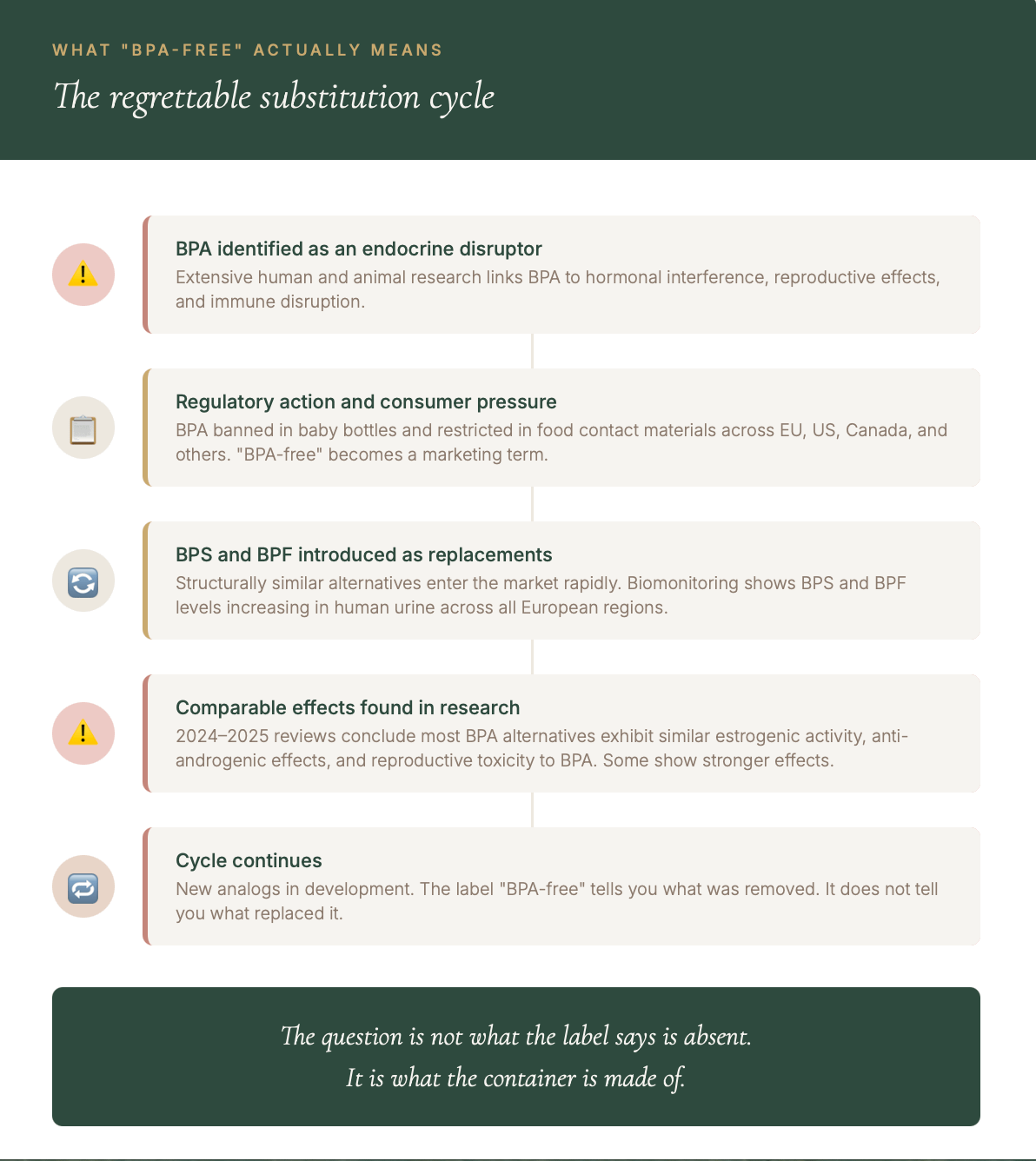
Toxicologists call this regrettable substitution: one harmful chemical replaced by another with a similar structure and similar biological effects. A 2025 review concluded that most mainstream BPA alternatives exhibit estrogenic activity, anti-androgenic effects, metabolic disruption potential, and neurodevelopmental effects comparable to BPA itself.
The practical implication is not despair. It is that “BPA-free” is not a reliable indicator of safety. The more meaningful question is what the container is made of. Glass, stainless steel, and food-grade ceramic have the strongest track record. They don’t require you to trust a label.
What are phthalates?
Phthalates are plasticizers: chemicals added to plastics, particularly PVC, to make them soft and flexible. They are also used as solvents and fixatives in synthetic fragrance, which is why they appear in personal care products, cleaning products, air fresheners, and anything with a synthetic scent. They are not chemically bonded to the materials they are added to, which means they migrate out continuously, releasing into food, air, and skin.
Phthalates interfere with the body’s hormonal system primarily as anti-androgens, and by disrupting the hypothalamic-pituitary-gonadal axis: the same communication network involved in the AMH signalling research discussed in an earlier letter. They alter the synthesis and secretion of reproductive hormones in ways that accumulate over time.
A systematic review published in September 2025 integrating four years of research found consistent evidence of phthalate-related reproductive effects across laboratory, animal, and human studies. Specific findings include reduced semen quality in men, menstrual disturbances in women, disrupted timing of pubertal onset in populations with elevated early-life exposure, and negative associations between urinary phthalate metabolites and AMH levels.
That AMH connection is worth sitting with. Multiple studies have found that higher phthalate metabolite levels in urine and follicular fluid are negatively associated with AMH levels and positively associated with FSH levels. As discussed in the Communications Biology review from May 2026, AMH is not a passive fertility marker. It is an active signalling hormone governing communication across the hypothalamus, pituitary, uterus, and placenta. Phthalates appear to interfere with the system that hormone is part of, not just a number it produces.
Prenatal exposure is where the evidence carries the most weight. Research shows that maternal phthalate exposure can disrupt thyroid hormone levels, sex hormone levels, and vitamin D homeostasis in pregnant women and offspring, with associations documented for preterm birth, gestational diabetes, and genital developmental differences in male infants. These effects occur during developmental windows when the hormonal system is being established, which is why the consequences can extend beyond the period of exposure itself.
Where do phthalates come from?
The exposure route most people underestimate is fragrance. Phthalates are used as solvents and fixatives in synthetic fragrance formulations, and they are not required to be listed on ingredient labels in most countries because fragrance compositions are protected as trade secrets. “Fragrance” on an ingredient list is a catch-all term that may or may not include phthalates. Fragrance-free is the most reliable position, not because natural fragrance is automatically safe, but because it removes the labelling ambiguity entirely.
Food contact with plastic packaging, and processed food in plastic packaging, are the other significant routes identified in the PERTH Trial’s observational cohort of 211 people.
Why this matters particularly for women
Hormones underpin every stage of female physiology.
At puberty, estrogen and progesterone drive development. Phthalates have been linked to disrupted timing of pubertal onset in populations with elevated early-life exposure.
During the reproductive years, the HPG axis coordinates the cycle, ovulation, and fertility. Both phthalates and bisphenols are documented to interfere with this system at multiple points.
During preconception and pregnancy, the stakes extend to the next generation. Chemicals that cross the placenta, and both BPA and phthalates are detected in cord blood, enter a developmental environment where the consequences of hormonal disruption can be long-lasting.
During breastfeeding, what accumulates in the body can transfer to an infant whose detoxification systems are not yet fully developed.
During perimenopause and menopause, a system already in transition is navigating significant hormonal change. Adding environmental compounds that act on estrogen receptors into that picture is not trivial.
None of this means that exposure at any stage produces a predictable outcome. The relationship between endocrine disruptors and health is complex, dose-dependent, and shaped by individual biology, genetics, and cumulative exposure. But the consistency of the research across every life stage is one reason why understanding these chemicals is not a niche concern.
The cumulative exposure question
People often ask: but the dose is so small. One receipt. One container. One product. Does it really matter?
The answer requires understanding how modern exposure actually works. It is not one thing. It is the shampoo in the morning. The food packaging at lunch. The receipt from the coffee shop. The air freshener in the office. The cleaning products at home in the evening. The fragrance in the body lotion before bed. Each individual exposure may be small. The combined, continuous, daily load is what biomonitoring studies are measuring when they find these chemicals in the urine of nearly every adult tested.
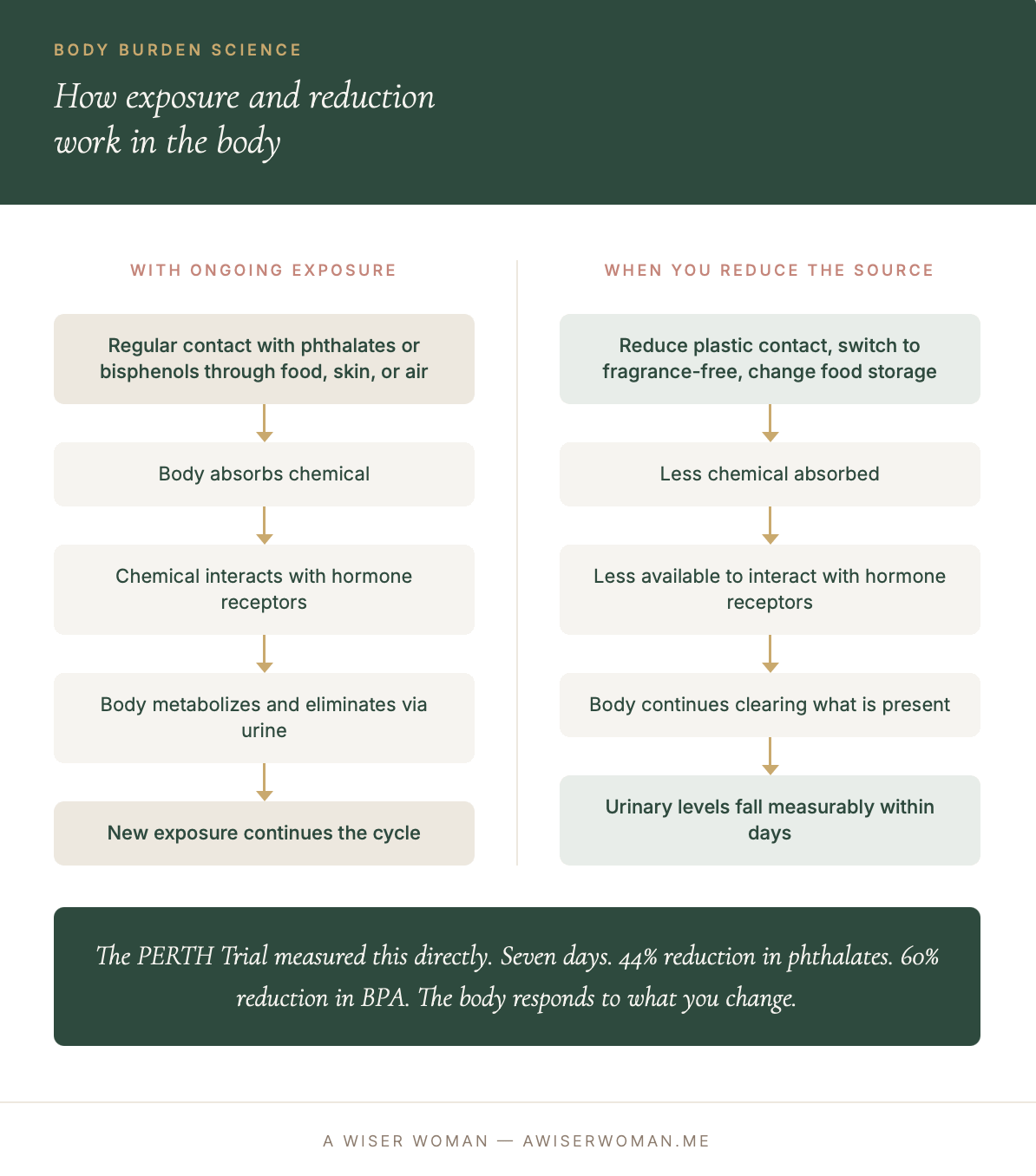
This is body burden: the cumulative load of everyday chemical exposures the body is processing at any given time. The question is not whether any single exposure is dangerous. It is what the sum looks like across a day, a week, a lifetime, and whether reducing the inputs measurably changes that sum.
The answer, as the PERTH Trial demonstrated, is yes.
The AWW Framework: how I decide what’s worth changing
Before telling you where to start, I want to share how I think about this, because the framework matters as much as the recommendations.
When I’m evaluating whether something deserves attention, I ask four questions:
Is the evidence strong? Not just “is this chemical associated with something bad in a lab study,” but is there human evidence, and how consistent is it?
How significant is the exposure? Something I encounter once a year is different from something I encounter multiple times every day.
Can I change it without making life harder? A change that requires significant expense, constant vigilance, or removing something I actually need is a different category from one that is simple, free, and sustainable.
Is there evidence that changing it actually changes biology? This is the AWW standard. Not “this chemical is theoretically harmful.” What actually happens in the body when people reduce this specific exposure?
If the answer to most of these questions is yes, it earns my attention. If it fails on multiple counts, I don’t lose sleep over it. That is the filter. Not fear. Not perfectionism. Evidence, exposure, cost, and demonstrated biological response.
Where to start
No cost, high evidence:
Stop heating food in plastic. Use ceramic, glass, or stainless steel for anything warm. This removes one of the highest-concentration exposure moments in the average day, and it is the single change most directly supported by the PERTH Trial evidence.
Decline paper receipts where possible. If you handle them regularly, wash your hands before eating or touching your face. If you use hand sanitizer and then handle receipts, that combination meaningfully increases dermal absorption of bisphenols.
Open windows for ten to fifteen minutes daily. Phthalates accumulate in indoor air through off-gassing from products and materials. Ventilation is consistently evidence-backed and costs nothing.
When replacing items naturally:
Switch personal care products to fragrance-free formulations as your current ones run out. Not necessarily natural or expensive. Fragrance-free is the relevant criterion. The HERMOSA trial found that switching to products free of phthalates and parabens for just three days reduced urinary paraben concentrations by 43-45%. Three days.
Replace plastic food containers with glass or stainless steel as they wear out, starting with the ones used for hot food. Do not discard functioning items. Replace them as they reach end of life.
For canned food, prioritize fresh or frozen alternatives for the highest-acidity items: tomatoes, citrus-based sauces, canned fish. The epoxy lining in cans is where bisphenol migration is most significant for food contact.
When reading labels:
“BPA-free” is not sufficient reassurance. Ask what the product is made of. Glass, food-grade stainless steel, and uncoated ceramics are the materials with the strongest evidence base.
The honest summary
Phthalates and bisphenols are two of the most studied synthetic chemicals in the human body. The evidence for their endocrine-disrupting properties is extensive and consistent across laboratory, animal, and human research. The evidence that reducing exposure measurably changes biological markers is also real, demonstrated in randomized controlled trials with measurable results within days.
What the evidence does not support is the claim that a single swap will transform your health, or that you need to spend thousands replacing everything in your home at once. What it does support is something more useful than that.
The body responds to what you change.
Not slowly, not imperceptibly, not after years of effort. Within days, in some cases. Because these chemicals have short biological half-lives. The body is designed to clear them. It just needs the incoming load to reduce.
That is not a small thing. That is your biology working in your favor, the moment you give it the chance.
I don’t believe women need more fear. We have enough of that already.
What I think we need is better information. Because once you understand where the evidence is strongest, the next step becomes surprisingly simple.
You don’t have to change everything. You only have to change the things that actually matter.
And thankfully, the science is getting better every year at helping us identify exactly what those are.
Sources
Harray AJ et al. “Low-plastic diet and urinary levels of plastic-associated phthalates and bisphenols: the randomized controlled PERTH Trial.” Nature Medicine (2026). DOI: 10.1038/s41591-026-04324-7
Harley KG et al. HERMOSA study. Environmental Health Perspectives (2016).
Dairkee SH et al. “Reduction of daily-use parabens and phthalates reverses accumulation of cancer-associated phenotypes within disease-free breast tissue.” Chemosphere (2023).
European Food Safety Authority. Re-evaluation of tolerable daily intake for BPA (2023).
European Environment Agency. HBM4EU bisphenol biomonitoring data (2024).
“A health conundrum of bisphenol A and its alternatives.” Journal of Environmental Exposure Assessment (2025). DOI: 10.20517/jeea.2025.39
“A systematic literature review of reproductive toxicological studies on phthalates.” International Journal of Molecular Sciences (2025).
“Phthalates disrupt female reproductive health.” PMC (2025).
Li et al. Communications Biology 9, 658 (2026). DOI: 10.1038/s42003-026-10273-1
The HERMOSA stat is one I keep coming back to: 43-45% reduction in urinary paraben concentrations after just three days of switching products.
Three days. That’s short enough to actually motivate change rather than just generate anxiety.
The fragrance section is the part most people miss. “No parabens” on a label tells you nothing about what’s hiding under “fragrance” in the same formula. The gap between what’s disclosed and what’s actually present is where so much daily exposure lives.